

With few exceptions, every woman’s body is capable of laboring and giving birth with little to no intervention. However, it is important to stock your toolbox with realistic
expectations, practical coping skills, and strong mental preparation before you undergo what is likely to be the most transformative work of your life.
In addition to understanding how labor works, most of us want to know what labor really feels like, how long it will last, and whether or not we will be able to handle it. Though we cannot guarantee an easy journey, we hope to build up your mental game, and encourage you to embrace whatever comes your way. Let’s start with the nuts and bolts of what labor is and how it works.
How long will labor last?
Normal labor can range from under an hour to 48 hours or longer. Thankfully, both extremes are rare, and most labors fall within a 3 to 24 hour timeframe. For the average first-time mother (or VBAC without prior labor), it’s reasonable to expect labor to last 12-18 hours or more from start to finish, and subsequent births are generally shorter. It’s a good idea to plan for something a little on the longer side, and allow yourself to be pleasantly surprised if it’s shorter.
Everyone hopes for a short labor. However, short labors are not necessarily easier labors. It often ends up feeling much more intense, as you will still do the same amount of work as a woman who has a longer labor! It’s like sprinting a marathon. On the other hand, many women dread hearing about long labors. Rest assured, the vast majority of these hours are spent in early labor, which is the easiest phase of labor. Long labors are nothing to fear for the well-rested, well-nourished, well-supported woman who has prepared her mind and emotions to surrender to her unique labor.
What does labor look like, physically and emotionally?
Labor is divided up into three stages, and the first stage is broken up into three phases. Each stage progresses into the next in varying ways, with a lot of overlap. While very few people have a “textbook” labor, it’s valuable to understand normal progression.
Stage 1: Labor up to complete dilation (10 cm)
- Early labor (Phase 1): Contractions (7-20 min apart, 30-ish sec long) will efface (thin) your cervix and dilate it up to about 5-6 cm. You may feel excitement, relief, anticipation, anxiety for what’s ahead.
- Active Labor (Phase 2): Contractions (3-4 min apart, 45-60 sec long) will finish effacement, and dilate you from about 6 to 8 cm. You may feel very focused, determined, and a need for quiet, rhythm, and support.
- Transition (Phase 3): Contractions (2-3 min apart, 60-90 sec long) will finish dilating the cervix so there is nothing holding back the baby’s descent. This is the “I can’t do it” phase, and you may feel discouraged, frustrated, powerful, tired, or like you will be in labor forever.
Stage 2: Complete dilation to birth of your baby
- Pushing: The baby descends through the pelvis and the head passes under the pubic bone. You may feel relief, a second wind, frustration, motivation, exhaustion, satisfaction, and like you have to poop.
- Crowning: the baby’s head stretches the vagina and eventually emerges. This is accompanied by a strong, brief burning sensation called the “ring of fire.” You may be afraid you will tear and/or exhilarated at being able to feel your baby coming.
- Birth: Once the head is out, the rest of the baby may follow immediately, or it may take one more contraction. It’s a very slippery, pleasurable sensation for most. You may feel ecstasy, shock, relief, bliss, a little numb or overwhelmed.
Stage 3: Placenta is birthed
- Placenta detaches and is delivered after a few more contractions. You may not notice this phase much, and often your midwife will remind you that the placenta has to be delivered before your work is completely done. You may notice some cramping afterward, as well as occasional gushes of blood. This is normal.
How much will labor hurt? Can I have pain-free labor?
It’s important to understand that there is no way to make labor “easy.” It’s called labor for a reason–it’s serious work. While labor is an intense physical experience, and usually painful, there are a few women who experience what they would describe as pain-free labor. That said, it’s wise to expect to experience some pain during your labor.
Your ability to work with your labor pain is not about your physical pain tolerance, or a particular birth technique. In fact, labor is primarily a mind game. While there is no way to guarantee pain-free labor, or to get out of the work of labor, having a healthy mindset can help set you up for an empowering, worthwhile experience, pain or no pain. Two things that make this process easier to integrate are:
- Making your own decisions in a shared process with your provider and being supported.
- Having realistic expectations about labor, and preparing to be flexible when labor comes.
Playing the labor mind game well involves the ability to hold your expectations loosely, surrender completely to your unique labor, and let your body take over. Labor will happen, with or without you. It’s critical to learn how to get out of your own head, trust your body and your baby, and come along for the ride.
One really cool fact about labor is that labor contractions are caused by oxytocin, the hormone released during
love-making. Labor is, at a chemical level, a “labor of love.” Remembering that it is literally your love that brings your baby into the world is a powerful thought that can help you stay on top of your pain.
Another way to help your mind game is to remember the following:
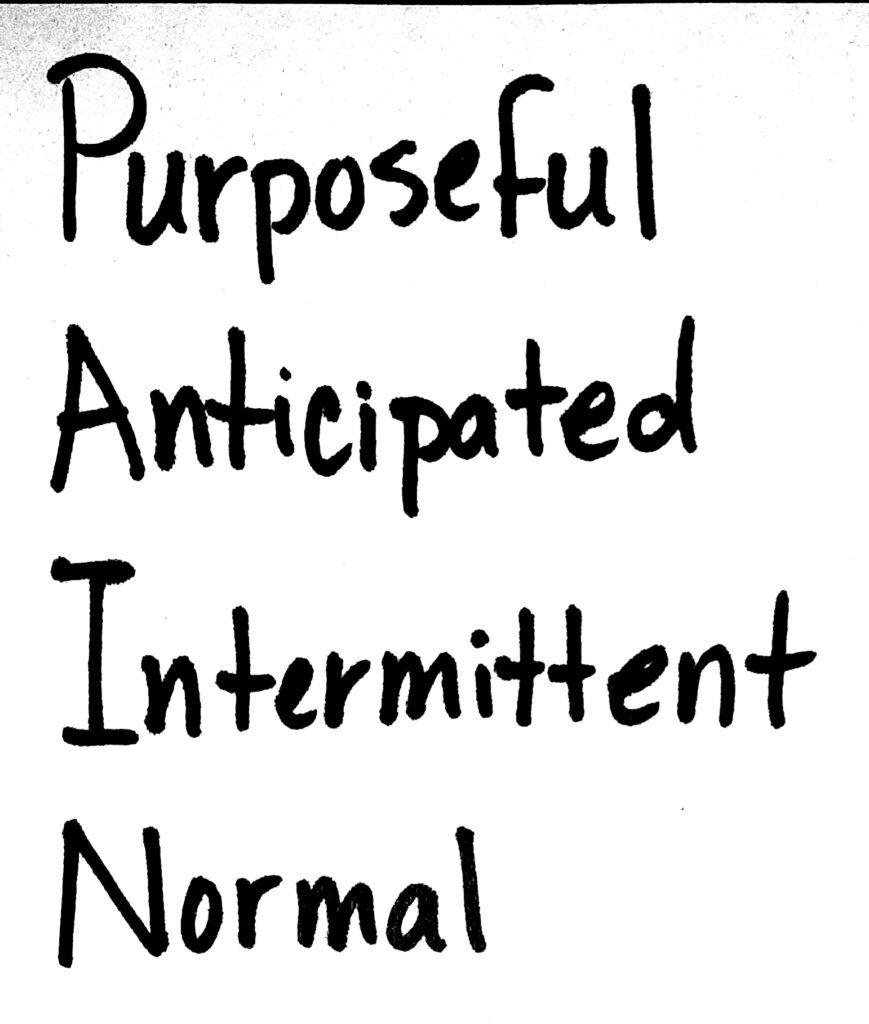
Pain in labor is PURPOSEFUL. It is through pain that your baby is brought from your womb to your arms. Visualizing your baby can be a powerful coping tool, and help you ride it out.
Pain in labor is ANTICIPATED. You know it’s coming and you can prepare for it! Classes, reading, and practicing various techniques are all wonderful ways to build yourself a toolbox packed with labor coping skills.
Pain in labor is INTERMITTENT. Except for transition, you will be resting more than you are working in labor. The further you get in labor, the less rest you have, but there will always be a break between contractions.
Pain in labor is NORMAL. Unlike the pain of a broken femur or a toothache, pain in labor is not a sign that something is wrong. It’s more like the pain felt
during a long run, just before the “runner’s high” hits. And just like this example, the euphoria at the finish is strong and real.
Finally, it’s important to understand that almost nothing truly good in our lives comes to us without some sort of pain or effort. Childbirth is no different. Even if you experience pain-free labor, it will be intense, powerful, and at times, overwhelming. It is a normal rite of passage into motherhood. And you are strong enough, brave enough, and fully capable of doing this incredible work.
What do contractions actually feel like?
Labor contractions are different from the Braxton-Hicks you may have already been feeling, and these “practice
contractions” generally stop completely once true labor begins.
A real labor contraction begins as cramping, either very low in the pubic area, or in the lower back, and has a wave-like sensation as it moves around to the front, or up in a wrapping motion. It builds to a peak, then drops away, allowing you a break in between. The top of your uterus gets very firm, there may be a strong squeezing sensation, and as the baby descends, powerful pressure in your pelvis and, eventually, your rectum.
How do I time contractions?
We recommend that you download any free contraction timer app, but before you use it, it’s important to understand how timing actually works. Take a look at the following diagram as you read the instructions below.
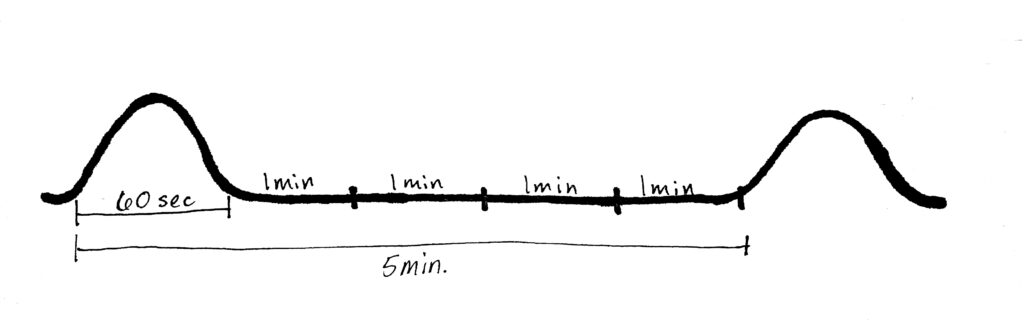
- Start the timer at the beginning of a contraction, then stop the timer when you feel your contraction beginning to fade. This is how long they are. Sometimes, a contraction leaves a lingering sensation in between–this is not part of the contraction itself. Leave this out of the timing, or you’ll become convinced your contractions are 5 minutes long!
- Note the time from the beginning of one to the beginning of the next. This is how far apart they are. For example, there is a four minute break between the two contractions in the illustration above, but they are five minutes apart.
- Time contractions for either one hour, or until you reach 10 contractions, whichever comes first. Then, take a screenshot and send it to your doula and/or midwife to keep her updated. Then put the phone down and focus on working with your contractions.
How do I work with my contractions?
As stated above, labor is primarily a mind game. There are things you and your partner can do that will help you play the game well, and allow your body to work as efficiently as possible. And, as you seek to cope with what may be the hardest and most fulfilling thing you have ever done, think: Nutrition, Position, Action
Stage 1: Early Labor
- Nutrition: Eat and Drink normally. Carb Load if possible.
- Position: Try to act as if all is normal. If you need to pause for the contraction, you may want to lean on a wall, counter, chair, or person momentarily. Sitting in a rocking chair or on a ball may be comfortable, as well as snuggling in bed.
- Action: Normal activity with a focus on rest! Conserve your energy, nap, watch a movie, read a book. This is not the time to be moving around. Avoid doing anything to “get it going.” This almost always results in a labor that is longer than it needs to be, and depletes your energy before you get to the difficult parts. If it’s bedtime, go to sleep!
Stage 1: Active Labor
- Nutrition: Eat lightly. Crackers, cheese or yogurt, brothy soups, juices, popsicles. Nausea is common during transition, so choose foods you wouldn’t mind seeing again. Aim for 4 oz. of clear fluids every hour to stay hydrated and avoid the need for an IV.
- Position: Alternate upright with resting positions about every 30-60 minutes or as needed for comfort and to work baby down into the pelvis. Sit on the toilet for a few contractions whenever you pee. All fours, side-lying, slow dancing with your partner, “hanging” during contractions, squatting, knee-chest, leaning on counters or other surfaces while standing or kneeling, sitting on a birth ball, and even light walking around are all great positions for this phase.
- Action: Contractions will take concentration now, and you may like counter-pressure on your back. Keep your bladder empty. Whatever position you’re in, move your hips if it helps. If you are planning a water birth, now is the time to set up the pool, if you haven’t already. Soothing touch and massage from your partner between contractions is often helpful. If you are moaning or making noise, remember to make low-pitched noises. Time some contractions and call your doula and midwife.
Stage 1: Transition
- Nutrition: Keep sipping water, juice, or other drinks often. You may or may not feel nauseous and throw up. This is normal.
- Position: Now is when there is no “comfortable” position. More supported positions are better: side-lying with pillows between your legs, leaning over a couch or chair with pillows under your knees, hanging over the side of the tub or lying on your side in the tub. You will be very removed socially. Contractions will take all your concentration and you may zone out during the breaks. Counter-pressure on your back or hip squeezes can be really helpful as the baby starts descending
- Action: This is the time to persevere–it’s the only time when you work more than you rest. It’s hard to let go in between, but you must. You will need the emotional support of your birth team now more than ever. You may cry, scream, swear, and insist you aren’t capable of going on. Affirmations and reassurance are usually welcome. You will want physical support during contractions, but only if it is precisely what you want. No one will take it personally if you snap at someone or slap away their hand.
Stage 2: Pushing
- Nutrition: You may complain of being hungry, but probably won’t want food. Good options for a boost of energy include juices, sports drinks, popsicles, spoonful of honey, a bite of yogurt or toast.
- Position: Once you feel that “urge to push” you may instinctively choose a position and refuse to budge, or you may move around a lot, or you may look for guidance. Great pushing positions include squatting, sitting on the toilet, hands and knees, modified sitting, and kneeling.
- Action: It’s time to move. Now is when the baby has to maneuver through the bony pelvis and sometimes trying a bunch of positions is really helpful. Your birth team will need to help you to move from place to place, as all your energy is going into pushing with the contractions. Remember to take deep breaths in between, and rest completely to conserve energy.
Stage 2 Crowning/Birth
- Nutrition: Keep hydrating.
- Position: Now your position doesn’t matter so much. You may still want your partner right beside you, encouraging and helping you emotionally. But if you can, let your partner come look and put your own hands down to catch your baby! It’s amazing to watch and feel your child being born.
- Action: Rest and Bond. Enjoy these precious moments as you meet your new baby, count fingers and toes, and snuggle.
All of these are simple suggestions, meant to give you a general idea of ways to load your toolbox and up your mental game. Key to coping is believing in yourself, and when you can’t, rest in the belief of your support team. We’ve got you.
Do I need a doula?
We recommend strongly that all first time mothers, first-time natural or home birthers, and VBAC clients hire a doula. Seriously consider hiring one, and interview two or three before you decide. You can find a list of our favorites here.
Though your midwife cares about your comfort, it is the last thing on her mind when she is preoccupied with
monitoring you and your baby’s safety. In addition, it’s critical that your midwife is well-rested in order to care for you and your baby with a clear head, so she will choose to sleep whenever possible and will not come to stay until you are in well-established active labor.
A doula, however, is free to put your comfort at the top of her priority list, and they often arrive before the midwife to provide support and non-clinical guidance for you and your partner. The benefits of hiring a doula are evidence-based and wide-ranging.
Should I take a childbirth class?
We also recommend that all first-time parents, first-time home birthers, and those who are planning their first VBAC take a childbirth class unaffiliated with hospitals. As passionate as your midwife is to educate, there simply isn’t enough time in appointments to cover everything adequately!
What to look for in a good class:
- Accurate view of physiologic labor
- Evidence-based information regarding interventions, including their appropriate uses
- Strong focus on empowering partners to participate as much as they would like to
- Avoids promises of pain-free birth or ideal outcomes
- Promotes informed consent/refusal and shared decision-making
- Speaks honestly and positively about all birthing spaces, including hospitals
- Helps you connect with your partner and community
- Addresses healthy postpartum recovery & breastfeeding norms.
- Incorporates some elements of fun and hands-on techniques
It’s a good idea to look into two or three different classes in different formats, and choose the one best suited to your personality, philosophy, and schedule. Ideally, you should finish the last class in a series no later than 36 weeks. This is so that everything is still fresh in your mind when you go into labor, but there’s plenty of time to nest and practice what you’ve learned. You can find a list of our favorite options here.
NOTE: If you have to choose between hiring a doula or taking a childbirth class, choose a doula!
Remember–Labor is a mind game. Learn to play it well!
Educating yourself, having realistic expectations, being flexible, and taking responsibility for your own childbearing journey are the keys to the process of childbearing and labor. A good foundation built on knowledge, healthy support, and a wide array of practical tools can increase your ability to integrate your experience in a healthy way, regardless of how it all plays out in the end.